Key economic indicators of Brazil - Statistics & Facts
Brazil, the largest economy in Latin America and one of the biggest globally, is a nation of contrasts. With a gross domestic product (GDP) of 2.2 trillion U.S. dollars in 2023 and as a member of key economic organizations such as the G20, WTO, and Mercosur, Brazil's role in the global economy is substantial.
However, the country's GDP per capita, standing at 10,044 U.S. dollars in 2023, reveals a different perspective, placing it in the 18th position of Latin America and the Caribbean — behind regional competitors like Argentina (14th) and Mexico (13th). This discrepancy highlights the ongoing challenges Brazil faces in ensuring equitable economic growth.
The Brazilian unemployment rate fell to 7.95 percent in 2023, with regional disparities and persistent informal employment, which has stabilized at 36-39 percent in recent years. Despite these challenges, Brazil boasts one of the lowest informal employment rates in Latin America.
Brazil’s commodity-led economy faces inequality and environmental strain despite a rebound in GDP and FDI. Sustaining growth requires the country to address structural issues such as infrastructure deficits, income inequality, and environmental sustainability to maintain long-term growth.
However, the country's GDP per capita, standing at 10,044 U.S. dollars in 2023, reveals a different perspective, placing it in the 18th position of Latin America and the Caribbean — behind regional competitors like Argentina (14th) and Mexico (13th). This discrepancy highlights the ongoing challenges Brazil faces in ensuring equitable economic growth.
From economic boom to recession
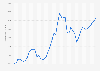
Between 2000 and 2014, Brazil's economy soared along with its BRICS peers, fueled by a global commodities boom that boosted demand and prices for oil, agricultural crops, and metals. Nonetheless, the commodity-driven growth proved volatile, leading to economic downturns. The 2014-2016 recession, followed by a slow recovery, resulted in a slowdown of the GDP growth in the years before the pandemic, remaining below two percent annually. However, recent years have shown improvement, with the GDP growth exceeding three percent from 2021 to 2024, including a peak of 4.76 percent in 2021. Nevertheless, this economic expansion has been closely linked to the ongoing issue of deforestation, as the demand for agricultural products leads to the dismantling of the Amazon rainforest.Foreign investment trends
Following the 2014 commodity shock, foreign direct investment (FDI) in Brazil dropped significantly, from over 90 billion U.S. dollars in 2012 to 44.7 billion in 2020. However, by 2023, FDI had rebounded to 64 billion U.S. dollars, with the service sector attracting a substantial portion. Despite this recovery, challenges such as sub-optimal infrastructure, high transportation costs, and low productivity continue to hinder further investment.Employment and sectoral composition
Approximately two-thirds of Brazil's GDP stems from the service sector, reflecting patterns typical of economies more developed. In 2022, the sector employed 70 percent of the total workforce, with the retail, trade, and automobile repair sector being the largest employer, accounting for nearly 13.2 million jobs. Despite the strong presence of services, the country continues to rely on commodity exports, having established itself as a major producer of several goods, such as beef and veal.The Brazilian unemployment rate fell to 7.95 percent in 2023, with regional disparities and persistent informal employment, which has stabilized at 36-39 percent in recent years. Despite these challenges, Brazil boasts one of the lowest informal employment rates in Latin America.
Brazil’s commodity-led economy faces inequality and environmental strain despite a rebound in GDP and FDI. Sustaining growth requires the country to address structural issues such as infrastructure deficits, income inequality, and environmental sustainability to maintain long-term growth.